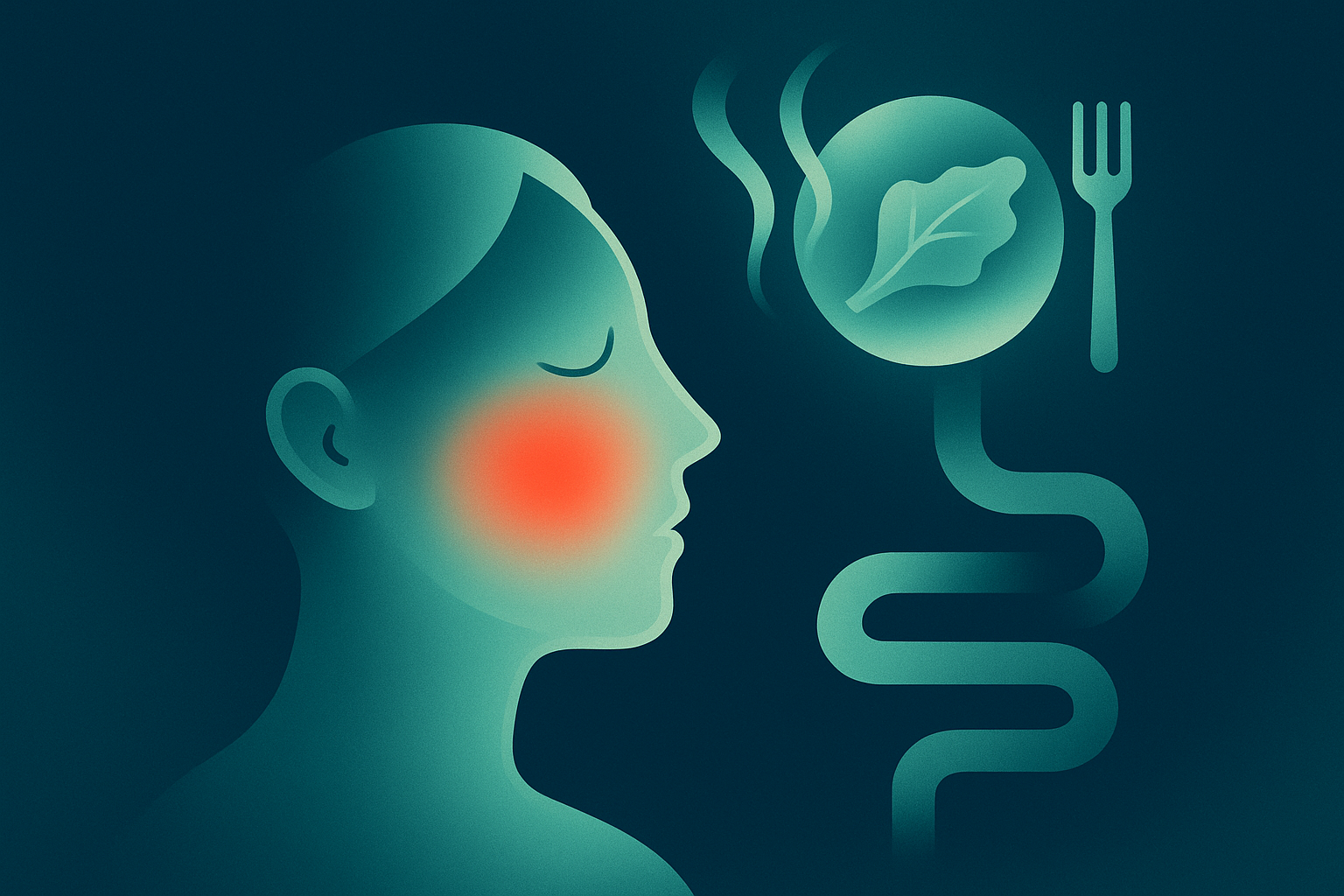
The Mechanics of a Post-Meal Flush
Facial flushing after eating is one of the most visible things your body does in real time. When blood vessels just beneath the skin widen (a process called vasodilation), more warm blood rushes to the surface — and because the face has dense, superficial capillary networks across the cheeks, nose, and forehead, even small shifts in circulation show up as color.
Eating is naturally a circulatory event. Digestion increases blood flow to support the gut, your metabolism ticks up to process the meal (a phenomenon known as diet-induced thermogenesis), and your nervous system shifts gears. For many people, a mild, brief warmth in the face after a satisfying meal is simply the body doing its job.
The more interesting story is in the pattern: which foods trigger it, how quickly it appears, how long it lingers, and what else you feel alongside it. Color, in other words, is information — and the face is a uniquely readable surface for it.
Common Triggers Written on Your Face
Not all flushing is the same, and the cause is often hiding in what was on your plate. A few well-documented dietary triggers:
- Spicy foods: Capsaicin, the compound in chili peppers, activates heat-sensing receptors that prompt vasodilation and sweating — a flush that feels genuinely warm and often centers on the cheeks and forehead.
- Alcohol: Particularly common in people with reduced activity of the enzyme that metabolizes acetaldehyde, leading to a fast, pronounced facial redness sometimes called "alcohol flush."
- Histamine-rich foods: Aged cheeses, cured meats, fermented foods, and some wines carry or release histamine, which can widen blood vessels and produce redness in sensitive individuals.
- Very hot foods and drinks: Sometimes the flush is thermal — soup, coffee, or tea raising surface temperature directly.
- Sulfites and certain additives: Present in some processed foods and beverages, these can provoke a flushing response in people who are sensitive.
Noticing which of these consistently lights up your face is the first step toward eating in a way that feels better. The food–skin connection is rarely random; the same meal tends to produce the same response.
What the Color, Timing, and Pattern May Reveal
Beyond the immediate trigger, the characteristics of a flush can hint at what's happening underneath — always as a wellness signal to notice, never a diagnosis.
- Speed: A flush within minutes of the first bite or sip points toward a reactive sensitivity (think alcohol or histamine). A slower, gentler warmth that builds over a meal is more often ordinary digestive circulation.
- Location: Redness concentrated on the cheeks and nose has a different texture than a whole-face heat. Persistent redness in the central face that flares with food and other triggers can be a signal worth paying attention to over time.
- Companions: Flushing paired with other sensations — warmth, a racing feeling, congestion, or skin reactivity — tells a fuller story than color alone.
- Recovery: How quickly the color fades matters too. A flush that resolves in minutes reads differently than one that lingers.
None of these patterns is a verdict. They're prompts — observations that help you connect how you eat to how your body and skin respond, and to flag anything persistent for a professional who can look deeper.
The Skin–Nutrition Connection Behind the Redness
Your skin is not a passive wrapper; it's an organ richly supplied with blood vessels and constantly reflecting your internal state. That's why nutrition and circulation show up on the face so readily. Regional skin color and evenness are influenced by blood flow, hydration, the foods you've eaten, and your nervous system's moment-to-moment tone.
This is also why a single flush in isolation tells you so little, while a trend tells you a lot. If certain meals reliably redden your cheeks, that recurring signal is your body offering feedback about what agrees with it. Some people find that lowering high-histamine or heavily processed foods, staying well-hydrated, and balancing meals with steady protein and fiber reduces the intensity of post-meal flushing — though responses are highly individual.
The research on skin barrier function and the role of nutrients like omega-3 fatty acids, vitamin C, and polyphenol-rich plant foods underscores how closely diet and skin appearance are linked. The redness you see after a meal sits at the intersection of what you ate and how your skin's vasculature responded.
Tracking Your Flush Over Time With Facial Signals
Because flushing is so visible, it's an ideal signal to track — and tracking is where casual observation becomes genuine self-awareness. The challenge is that memory is unreliable: it's easy to forget which lunch left your cheeks warm three days ago.
This is where Soma's approach fits naturally. Soma reads wellness signals from a single front-camera selfie, mapping 478 facial landmarks and analyzing 85 biomarkers across 12 facial regions — including the cheeks and T-zone where flushing tends to appear — in about a second. Regional skin tone and color distribution are exactly the kinds of features the engine reads, expressed as how you compare to a population baseline rather than a raw number.
A few principles for making sense of your own flushing:
- Scan or note consistently: A reading right after meals, captured the same way each time, makes patterns visible that a single snapshot can't.
- Pair color with context: Log what you ate, how fast the flush appeared, and how you felt. The food is half the story.
- Watch the trajectory, not the moment: Longitudinal tracking turns scattered observations into a trend you can actually act on.
Soma is a frictionless, non-invasive wellness layer — designed to help you notice trends in how your face responds, not to deliver a medical verdict. Skin-related signals are still in active validation, so treat readings as informational prompts to pay attention. Persistent or severe flushing always deserves a conversation with a qualified professional.
Frequently Asked Questions
Is facial flushing after eating normal?
A mild, brief warmth in the face after a meal is common and often just ordinary digestive circulation — blood flow increases to support digestion and metabolism. Frequent, intense, or fast-onset flushing tied to specific foods is worth noticing as a pattern, and anything persistent or distressing is worth discussing with a professional.
Which foods most commonly cause facial flushing?
The most frequent dietary triggers are spicy foods (capsaicin), alcohol, histamine-rich foods like aged cheese, cured meats and fermented items, very hot foods and drinks, and certain additives such as sulfites. Tracking which of these consistently reddens your face helps you identify your personal triggers.
Why do I flush so quickly after drinking alcohol?
Fast facial redness after alcohol is often associated with reduced activity of the enzyme that breaks down acetaldehyde, a byproduct of alcohol metabolism. This causes acetaldehyde to build up and trigger vasodilation. It's a common, largely genetic response and a clear example of a visible signal tied to how your body processes what you consume.
What does the color and timing of a flush reveal?
Speed and location offer clues: a flush within minutes points toward a reactive sensitivity like alcohol or histamine, while a slow warmth over a meal is more often normal circulation. Redness centered on the cheeks and nose reads differently than whole-face heat. These are wellness signals to observe over time, not diagnoses.
Can a face scan help me understand my post-meal flushing?
A tool like Soma reads regional skin tone and color across 12 facial areas from a single selfie, expressed as how you compare to a population baseline. Captured consistently and paired with a food log, this can help you notice trends in how your face responds to meals. It's for general wellness awareness, not a medical measurement — skin signals are still in active validation.
How can I reduce facial flushing after meals?
Many people find it helps to identify and moderate personal triggers like alcohol, very spicy or high-histamine foods, stay well-hydrated, and let hot foods cool slightly before eating. Responses are highly individual, so tracking your meals against your flushing pattern is the most reliable way to learn what works for you.